

About Us
Sanjeevani Ayurveda, is a centre for healthcare through authentic
Ayurveda established by Dr Geeta Patil.
Dr Geeta is an ayurvedic Consultant with over 20 years of experience. She
treats patients by giving indetail counselling regarding treatment , diet and
lifestyle management and if necessary customised Panchakarma
therapies.
Contact Info
- Bangalore, India
- (+91) 7483065036
- wellness.sanjeevani@gmail.com
- All Days Open: 8.00AM to 8.00PM
Blog
3 Myths About Stress, Busted by the Ancient Wisdom of Ayurveda
In our fast-paced world, stress is often discussed as an unavoidable byproduct of modern
life. We manage it with calendars, coping mechanisms, and quick fixes. But what if our very
understanding of stress is flawed?
Ayurveda, the 5,000-year-old "science of life" from India, offers a radical and holistic
lens. It sees the individual as an integrated ecosystem of mind, body, and spirit. From this
viewpoint, many common beliefs about stress are not just incomplete—they’re myths that
prevent true healing.
Let’s dismantle three of the biggest myths about stress through the profound wisdom of
Ayurveda.
Ayurvedic Lens: The Inseparable Mind-Body Connection
Before we bust the myths, we must understand the core Ayurvedic principle: the mind and body
are a single, continuous field. They communicate via a foundational matrix called
Tridosha—the three dynamic energies of Vata (air/space), Pitta (fire/water), and Kapha
(earth/water).
Every thought, emotion, and experience has a physical counterpart in the doshas. Stress
isn’t just a "feeling"; it’s a tangible, physiological event that disturbs our inner
balance. This is the key to seeing through the myths.
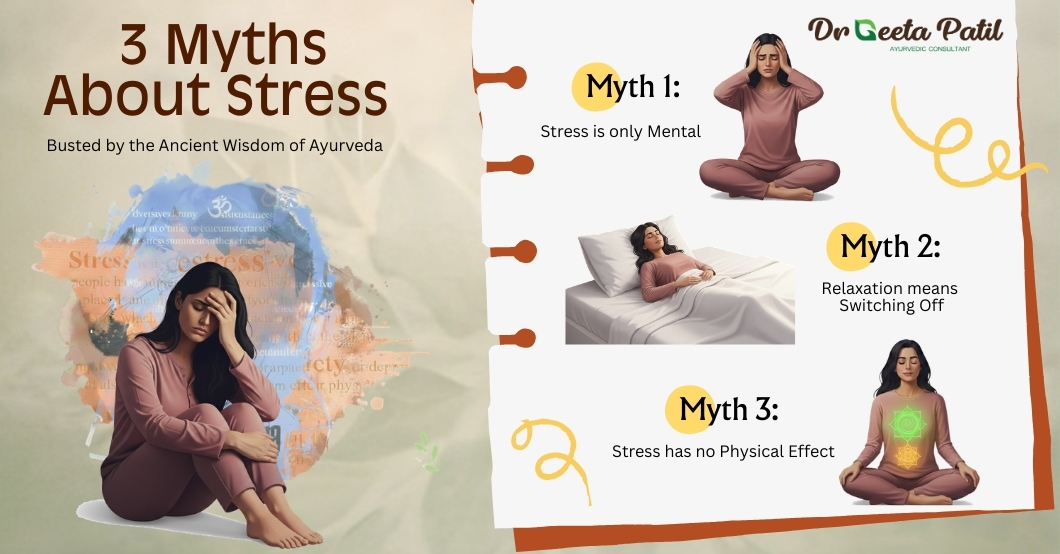
Myth 1: Stress is Only Mental
The Modern View: We often locate stress "in our head"—a series of anxious thoughts, worries,
and mental overload that we try to think our way out of.
The Ayurvedic View: Stress is a full-body experience that often first manifests as a
disturbance in Vata Dosha.
Ayurveda identifies Vata, composed of air and space, as the principle of movement. It
governs the nervous system, circulation, breath, and the very movement of thought. When we
experience a stressor—be it a deadline, an argument, or information overload— Vata is
commonly the first dosha to become aggravated.
What This Looks Like:
- Physically: Your breath becomes shallow and irregular (Vata governs breath). Digestion becomes erratic, leading to gas or bloating (Vata governs movement in the gut). Your sleep becomes light and interrupted.
- Mentally: The mind becomes scattered, restless, and filled with "what-if" scenarios—a classic sign of aggravated Vata.
The Takeaway: You cannot address a "mental" stress issue without calming the physical body. Calming Vata through warm, grounded food, regular routine, and self-massage (Abhyanga) is the first step to calming an anxious mind.
Myth 2: Relaxation Means Switching Off
The Modern View: Relaxation is often about "zoning out"—collapsing on the couch, scrolling
through social media, or binge-watching a show. We seek to numb the mind.
The Ayurvedic View: True relaxation is a state of conscious, aware rest—it's about switching
on your parasympathetic nervous system ("rest and digest"), not switching off your
awareness.
Passive stimulation (like screen time) often further aggravates Vata and Pitta, depleting
the mind. Ayurveda advocates for active relaxation that nourishes your specific constitution
and current state of imbalance.
What This Looks Like:
- For a Vata (anxious, scattered) mind: Relaxation is grounding. A gentle walk in nature, warm oil massage, or restorative yoga poses.
- For a Pitta (angry, driven) mind: Relaxation is cooling and releasing. Moonlit walks, swimming, or sweet, calming music.
- For a Kapha (lethargic, heavy) mind: Relaxation is gentle invigoration. A brisk walk, dry brushing, or uplifting music.
The Takeaway: Effective relaxation is intentional and sensory. It’s about choosing activities that bring your specific doshas back into harmony, creating a deep sense of rejuvenation, not just distraction.
Myth 3: Stress Has No Lasting Physical Effect
The Modern View: We often treat stress as a temporary mental state that passes. Once the
stressful event is over, we expect the body to simply return to normal.
The Ayurvedic View: Unmanaged stress (vitiated Vata) doesn't just "go away." It migrates
deeper into the tissues, creating the root cause of chronic disease.
This is a cornerstone of Ayurvedic pathology. If the initial Vata disturbance is not
pacified, it will:
- Disturb Agni (Digestive Fire): Leading to poor digestion and the creation of Ama (toxins).
- Carry Ama into the Channels: This toxic sludge, created by undigested food and undigested emotions, clogs the subtle and physical channels of the body.
- Lodge in a Weak Tissue: Over time, this combination of imbalanced Vata and Ama settles in the weakest part of your system, which over time may contribute to chronic imbalances in the body.
These imbalances may appear as:
- In the joints (such as stiffness or pain - Vata site)
- In the digestive tract (such as sensitivity or inflammation - Pitta site)
- In the lungs or sinuses (such as congestion - Kapha site)
The Takeaway: That "butterflies in the stomach" feeling is a warning light. Chronic stress is not a life sentence; it's a call to action. By managing stress daily through diet, routine, and mindfulness, we prevent the formation of Ama and protect our long-term physical health.
The Ayurvedic Path Forward: From Myth to Wisdom
Ayurveda frees us from the fragmented view of stress.
Because each individual has a unique Prakriti (constitution), stress may manifest
differently in different people. It teaches us to:
1. Listen to the body's early whispers (like poor sleep or digestion) as signs of stress.
2. Engage in conscious, dosha-balancing relaxation daily.
3. Honor the deep, lasting connection between our emotional state and our physical well-being.
Start simple. Establish a daily routine (Dinacharya), prioritize early bedtime, and eat
warm, cooked meals at regular times. These are not just "lifestyle tips"; in Ayurveda, they
are profound medicine for calming Vata, which plays a central role in the stress response,
and building a resilient and integrated life.
Dr. Geeta Patil
Sanjeevani Ayurveda